

Opinion piece – This material represents a personal analysis and theory about the evolution of the global financial system and should not be interpreted as proven fact or financial advice. It is not an economic report. It is not an investment recommendation. It is simply my opinion after 10 years spent watching Bitcoin, the financial markets, and how money moves on a global scale.
Introduction
In recent years I have closely followed the financial markets, the evolution of Bitcoin, the growth of global debt, and the economic changes taking place at an unprecedented pace.
Recently, in a single day, the financial markets lost roughly 665 billion dollars in capitalization, of which more than 90 billion came from the cryptocurrency market alone. Such events are repeating more and more often, and they raise a simple question: is all of this just normal market volatility, or are we witnessing a profound transformation of the world's financial system?
In 2008, the world was hit by the financial crisis generated by the subprime mortgage market in the United States. Also in 2008, the Bitcoin White Paper appeared, signed by the mysterious Satoshi Nakamoto. Coincidence? Maybe. Or maybe not.
Here begins one of the most interesting questions of the modern era — one that has always fascinated me: who is truly behind the origin of Bitcoin? We were told that Bitcoin was created by Satoshi Nakamoto. The problem is that no one knows for certain who Satoshi Nakamoto is.
Perhaps Hal Finney? I personally tend to believe it is possible, from two perspectives: his wallet has never been touched since its creation, and Hal Finney passed away taking the "private keys" of his wallet with him… or perhaps he left them as an inheritance, to be accessed only when BTC reaches one million dollars? I am sure he believed that. And in Japanese calligraphy, Satoshi Nakamoto is written like this: サトシ・ナカモト …. HAL FINNEY … there is a certain resemblance — I'm sure you can see it too.
Still, even with these speculations, after almost two decades his identity remains one of the greatest mysteries of the digital era. Was he a brilliant programmer? Was it a group of developers? Was it an academic project? Or perhaps something far more complex?
Some have speculated over time that behind Bitcoin there could be organizations or agencies with extraordinary resources, including governmental or intelligence structures such as the NSA. There is no evidence to confirm this theory. But it is hard to ignore the fact that Bitcoin appeared at exactly the moment when the global financial system was going through the largest crisis in decades.
Coincidence? Maybe. But after almost 10 years spent in this industry, I have learned that sometimes the most interesting questions are the ones we still have no answer to. There is no evidence to confirm any single version, but the question remains open.
My theory: Bitcoin as a financial transition mechanism
Here we enter the realm of personal hypotheses. I believe it is possible that Bitcoin has become something far more important than its creators ever imagined.
Regardless of who created it, states and major financial institutions have realized that it represents the first truly limited digital asset in history. There are only 21 million Bitcoin. No more can be printed. They cannot be created by a political decision. They cannot be multiplied by decree.
For this reason, Bitcoin is starting to look more and more like gold — only in a digital form.
Bitcoin volatility: free market or redistribution mechanism?
Bitcoin is one of the most volatile asset classes in the world. Billions of dollars are liquidated in a single day. Traders lose, traders win, and funds are continuously transferred between participants.
My theory is that this enormous volatility is not merely a natural characteristic of the market, but also a process through which digital assets gradually pass from the hands of emotional investors into the hands of institutional investors.
Every time panic appears:
- the public sells;
- institutions buy.
Every time euphoria appears:
- the public buys;
- institutions distribute.
This behavior is observable across all financial markets and does not require the existence of a conspiracy in order to function. It is simply the psychology of the masses.
Bitcoin – the new gold of the 21st century?
I believe that over the next 10–20 years Bitcoin will be perceived similarly to gold. Not as a currency for daily purchases, but as a strategic asset. Just as states accumulate gold reserves, it is possible that in the future they will also accumulate Bitcoin reserves. Some states have already begun this process.
I entered the crypto market in 2016, when it was trading at around 870 dollars in December on Coinbase.
"Don't ask whether I still hold any of the ones I bought at 870 — I'm amazed myself that I held on until they reached 8,000. But a 10x in a single year is still pretty good, I'd say :)"
At that time, most people considered Bitcoin a joke. A fad. An experiment. Some said it would disappear within a few months. In 2017 I watched it climb from around 1,000 dollars to nearly 20,000 dollars.
The 2008 crisis and the emergence of Bitcoin
In March 2020 (COVID-19) I watched it crash down to around 3,850 dollars. (I pawned a car of mine just to buy again :) I saw people who said it was dead. Then I saw it come back, then surpass 20,000 dollars, then 50,000, then 100,000.
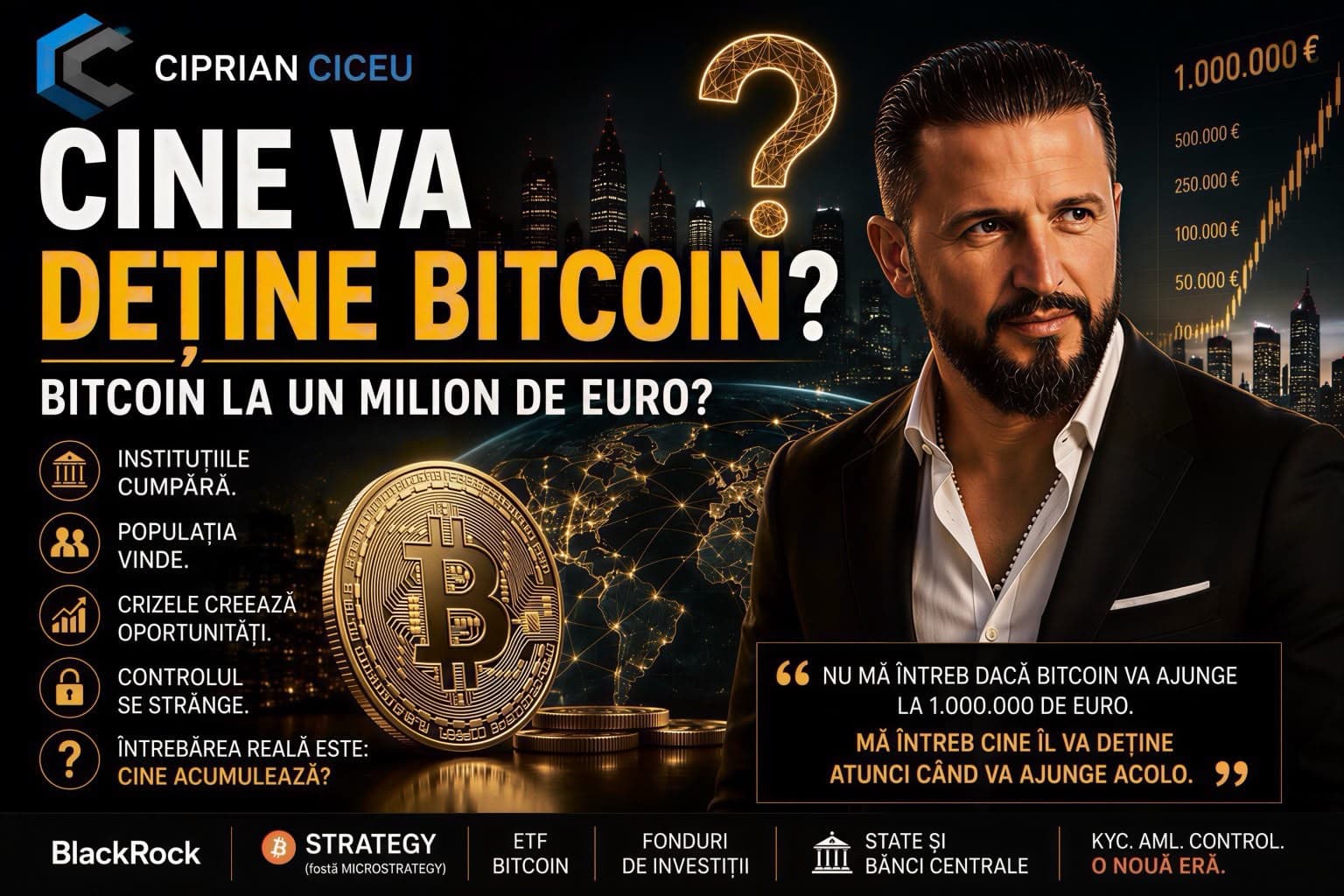
And precisely for this reason, today I no longer ask myself whether Bitcoin will survive. I ask myself who will own it, control it, and hold enough of it to manipulate the price. Because this is where I believe the real story lies.
In 2016 almost no one wanted Bitcoin. In 2026 it is being bought by BlackRock, by Strategy (formerly MicroStrategy), by the ETFs, by Elon Musk, by investment funds, by publicly listed companies — by institutions that just a few years ago were criticizing or completely ignoring it. Don't you ask yourselves why?
And exactly during this same period, we observe another phenomenon: it is becoming harder and harder to hold Bitcoin anonymously.
KYC, regulation, and control
We are already seeing a global trend:
- mandatory KYC checks;
- automatic tax reporting;
- stricter regulations for exchanges;
- monitoring of financial flows.
Authorities argue that these measures are necessary to combat fraud, money laundering, and the financing of illegal activities. Critics claim that they gradually reduce financial anonymity. Regardless of the perspective adopted, the direction seems clear: more transparency and less anonymity.
The question I ask myself is simple: if Bitcoin is merely a speculative asset, why is there such a great need to know exactly who owns it? Perhaps there are perfectly legitimate explanations — combating fraud, money laundering, and the financing of illegal activities. But it is impossible not to notice that, as the major institutions accumulate Bitcoin, the level of control and identification of users constantly increases. Coincidence? Maybe. Or maybe Bitcoin has already become too important to be ignored.
Another thing that fascinates me is the volatility. Every day we see billions of dollars liquidated — longs destroyed, shorts destroyed, accounts wiped out, people who lose years of savings in a single day. The media talks about those who lost. I look at something else: who is buying? Because when someone is liquidated, someone else buys. When someone sells in panic, someone else accumulates. When billions disappear from the market, the assets do not disappear — they change owner.
And then comes the question that has haunted me for years: are we perhaps witnessing one of the largest transfers of digital wealth in modern history? Not from institutions toward the public, but the other way around — from the public toward institutions.
Then there is the geopolitical component. I am not claiming that wars are started for Bitcoin — I have no evidence for that. But I observe certain things. I observe that energy, computing power, and digital infrastructure are all becoming more and more important. And I observe that Bitcoin depends directly on all of these elements.
So I allow myself to ask a few questions. Why has Greenland become so strategically important in recent years? Is it only about its geographic position, or also about resources, energy, climate, and future digital infrastructures? In a world where data centers and mining operations consume enormous amounts of energy, access to cheap energy and a cold climate can become an enormous strategic advantage. I ask myself the same about other energy-rich regions of the world.
Perhaps the answers are simple. Perhaps not. But I believe it is worth asking the questions, because great economic transformations are rarely fully explained at the moment they happen — usually they are understood years later.
Perhaps I am wrong. Perhaps all of these are simple coincidences. But after almost a decade spent watching Bitcoin, I have learned one thing: when everyone sells, someone is buying; when panic appears, someone profits; when billions are liquidated, someone accumulates.
And the question that interests me most is not whether Bitcoin will reach 1,000,000 euros — because of that I am convinced. The right question, the one that truly interests me, is: who will own the strategic assets when this transformation is complete?
And of all the assets that exist today, Bitcoin appears to be the one attracting the greatest attention from institutions, states, and investors alike. Perhaps in 10 years we will look back and discover that the real revolution was not the emergence of cryptocurrencies, but the transformation of Bitcoin into the strategic digital reserve of the 21st century. Who will own the majority of Bitcoin when it gets there?
Conclusion
I do not claim to hold the truth. Perhaps my theory is wrong. Perhaps it is only partially correct. But I believe we are living through one of the most important financial transitions in modern history.
We are seeing simultaneously:
- record global debt;
- the digitalization of money;
- the rise of Bitcoin;
- the accumulation of digital assets by institutions;
- the development of state digital currencies.
For me, the question is no longer whether the world's financial system is changing. It is who will end up holding the decisive assets once that change becomes irreversible.
Let's also see what quantum computers have in store for us in a future blog post… will they help mine Bitcoin, or will they crack the private keys of the "dormant" wallets? To be continued….
— Ciprian Ciceu
Fintech Entrepreneur | Blockchain Advisor | Founder of Mainet X
This article represents solely the personal opinion of the author and does not constitute financial advice or an investment recommendation.